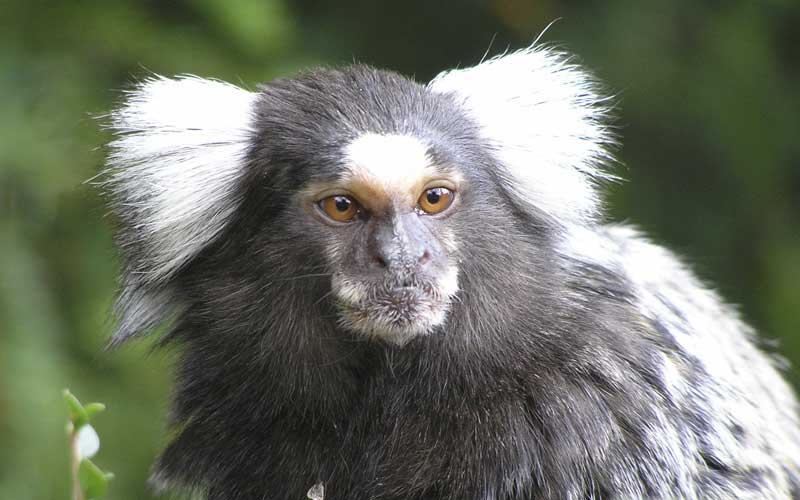
Common Marmoset
| Field | Value |
|---|---|
| Name | Common Marmoset |
| Latin Name | Callithrix jacchus |
| Where they live | Northeastern coast of Brazil |
| Colour | White, black, grey, beige |
| Diet | Spiders, tree sap, bird eggs, small vertebrates |
| Size | Males and females are of similar size with males being slightly larger. |
| Weight | Males weigh 256 g (9.03 oz) on average and females weigh 256 g (8.32 oz) on average. |
| Length | Males have an average height of 188 mm (7.40 in) and females have an average height of 185 mm (7.28 in). |
| Conservation status | Least concern |
| Worldwide population | Population |
| Size of group | 3-15 |
Introduction
Did you know the Common Marmoset is a very different type of monkey? Did you know it is often called the Cotton Eared Marmoset?
Description
The unique physical appearance of this monkey is very different. They have a grey body as they get older they develop white tuffs that extend from the sides of the face. They have a beautiful colourful tail that is very long and is grey and white striped. They can be up to 1 pound in size for males and even less for females. The males and females often look very very similar to each over. Surprisingly, this isn't common for most species of monkeys.
Distribution
Did you know the Northeastern coast of Brazil is where you will find the Common Marmoset. Today they are also found in Southern part of Brazil. They will move into new territories when they have a chance to do so. This may account for why they have been able to survive in their environment changes. Yet that could also be affecting other types monkeys negatively. They may be found along the edges of forests all the way into it. They are able to jump long distances and move quickly. In some cities such as Rio de Janeiro and Buenos Aires they have also been found.
Behaviour
Common Marmosets are very social and create groups that can be very large. There is plenty of social structure in the place that keeps them all in line. They may have only one mate or they can have harems where males have several females in a sub family. These Monkeys are very susceptible to a horrid variety of different diseases in the wilderness. Did you know these problems,which can be deadly,quickly spread through the group? There are high numbers of them known to contract Hepatitis as well as fungal disease problems.
Diet/feeding
Did you know the Common Marmoset eats spiders,tree sap,bird eggs,and small vertebrates which make up the diet of the Common Marmoset? They will eat well on what they can find and may be picky when food is plentiful. What is very interesting is that they are the only primates other than humans that may suffer from the eating disorder known as Anorexia.
Reproduction
Mating can take place any time of the year for Common Marmoset. However,it will typically occur when there is plenty of food. Once mating has taken place then it will be about 150 days before the young are born. Twins are extremely Common but there are times when 3 or 4 are born at once. The entire group helps to care for the very cute young. This includes the males and that helps to reduce anxiety among the group. It also helps to reduce the mortality rate. The average life span in the wild is 12 years and 16 years in captivity.
Conservation
There is no threat to the future for Common Marmoset at this time. However,there are conservation efforts in place to help secure their natural habitat. Studies show that humans are destroying there habitat is huge factor for many other species of monkeys. The idea is to make sure that doesn't happen to this one as well. Forest fires that are set to help regenerate agricultural growth also continue to their habitat being destroyed. They are often sold as pets for a very nice fee even though it is illegal. They usually sell for about $2,000 each. Therefore people do go into the natural habitat and remove them for illegal selling to make money. They are also sold for biomedical research due to how similar they are two humans.